
Renewable Asset Management: Monitoring vs. Control
Sit with an asset manager during a typical week. They open a monitoring dashboard. They see a chart. They may drill down to another chart. They open a second tab in their ticketing system, a spreadsheet, or an email thread to figure out whether the alert has been seen and whether anyone has acted on it. Then they reach out again, in email or Teams, to see if the resolution, if there actually is one, was the right one. Then they go back to the dashboard and try to remember where they were.
The dashboard is not where the work happens. It is where the work begins.
This is the gap that institutional capital is starting to write requirements around. Monitoring platforms surface state. They tell you what is happening. The platforms that investors actually trust are the ones that close the loop: that take the alert, classify it, route it to the right resolution path, track it through to completion, and leave behind a record that survives audit.
Monitoring vs. Control: Why Dashboards Aren’t Enough
A monitoring layer answers one question: what is the asset doing right now? Telemetry comes in, it is processed against thresholds and expected values, and the result is rendered as a dashboard or an alert.
A control layer answers a different question: what should happen next, and is it happening?
When a deviation is detected, the control layer classifies what kind of issue it is, whether telemetry gap, equipment fault, contract obligation lapsing, or compliance evidence overdue. It routes the issue to the right resolution path: an automated correction, a human queue with the context already attached, an O&M work order to a field provider, an escalation to compliance. It tracks the issue through resolution. And it produces a timestamped record — caught, decided, resolved — that an auditor can read.
Monitoring tells you something is wrong. Control tells you what was done about it.
Tax Equity Recapture, Debt Covenants and the Problem with Data Alone
Control matters because the people writing the checks— tax equity investors, lenders, and LPs— do not accept data as proof. They need records.
Tax equity recapture defense is not a question of whether your data is clean. It is a question of whether you can demonstrate, with a documented record, that the operational conditions supporting credit eligibility were maintained, and that when they slipped, you caught it and resolved it. The record is the defense.
Debt covenant proof is the same. The covenant does not ask whether the asset is producing. It asks whether the obligations that condition the loan are being met — and whether the proof can be reconstructed without hand-waving.
LP defensibility, in any quarterly review, comes down to whether the operational story you are telling can be backed up by records when someone asks the follow-up.
The artifact that institutional capital requires is the chain of custody — the record of “we caught it, we routed it, we resolved it, here is the timestamp.” It does not come from monitoring. It comes from closing the loop.
How a Renewable Energy Control Layer Works
Radian Digital’s control layer runs across the three categories of operational signals that determine whether an institutional asset is being managed, not just watched. The pattern is the same across all three. Detect. Classify. Route. Resolve. Record.
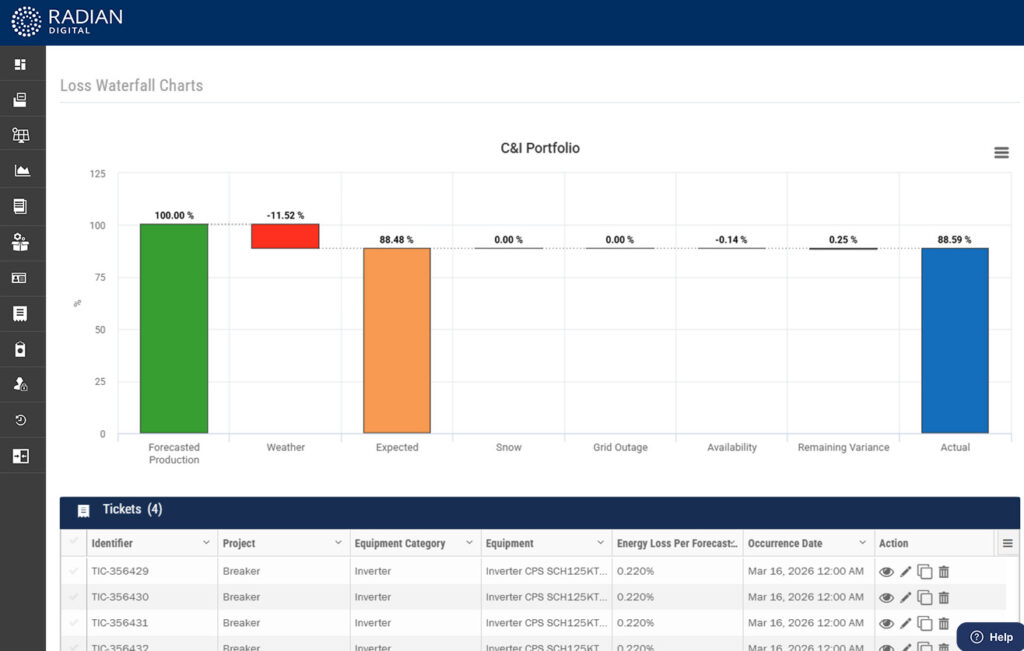
Telemetry — production, availability, equipment health — feeds the operational performance loop. Completeness checks flag gaps and anomalies against expected patterns. Issues are classified and routed to a performance engineer for diagnosis, an O&M partner for field work, or an asset manager for escalation.
Work orders, where generated, are tracked to closure under the same standards that made the detection meaningful. What comes out the other side is a verifiable record of issue and resolution, and an availability number that can be reconciled against contractual guarantees rather than asserted.
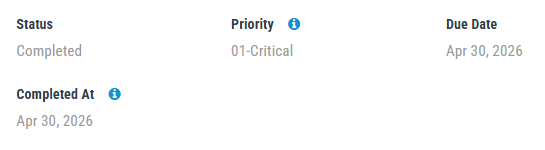
Compliance and contractual obligations
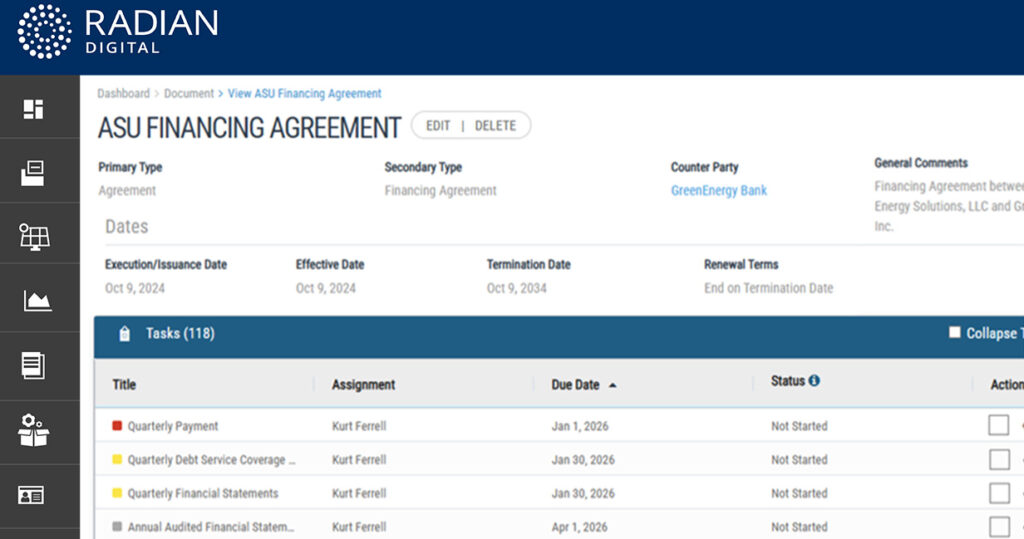
— regulatory items, agreement renewals, counterparty actions — feed the asset integrity loop. Expiration dates and evidence due dates are tracked. Items are surfaced before they become exceptions, classified by type, and routed to whoever owns the resolution. What comes out the other side is documented compliance, not a hope that someone remembered to renew the agreement.
Financials— budget vs. actual, production vs. hedge obligations, revenue vs. model — feed the financial performance loop. Variances are surfaced, investigated, notated, and acknowledged. What comes out the other side is a financial story that can be reconstructed when an LP, lender, or auditor asks the follow-up— not a spreadsheet that mostly agrees with the system of record.
Why Monitoring Platforms are Hard to Retrofit
The reason this gap exists in the market is not lack of awareness. Every monitoring vendor knows that customers want more than dashboards. The reason the gap persists is structural.
A control layer requires a team accountable for the loop being closed. The platform can detect and classify. It can route. It can record. But somewhere in the loop, someone — a human, a counterparty, or an AI agent — has to actually resolve the issue, and the resolution has to be governed by the same standards that made the detection meaningful in the first place. A platform without that accountability behind it produces alerts, not control.
This is why platforms with credible control layers tend to come from teams that operate the assets. Active management generates the discipline that makes loop-closing meaningful. Without that discipline, a control layer is just decoration over a monitoring system.
How to Audit Your Renewable Asset Management Platform
The next time you evaluate a platform, even your own, try this: Pick a single issue from the last quarter. Trace it through the platform. Can you see when it was detected? When it was classified, and into what category? Who it was routed to? When it was resolved, and by what action? Whether the resolution was reviewed against the standard?
If the trail goes cold at “alert sent,” you are looking at a monitoring platform.
If the trail goes all the way through to resolution and review, with timestamps at every step, you are looking at a control layer.
Run the same trace on five more issues from the last quarter. If the pattern holds, you are not looking at a tooling problem you can fix with a better dashboard.
The difference is not a feature. It is the difference between data and accountability.